
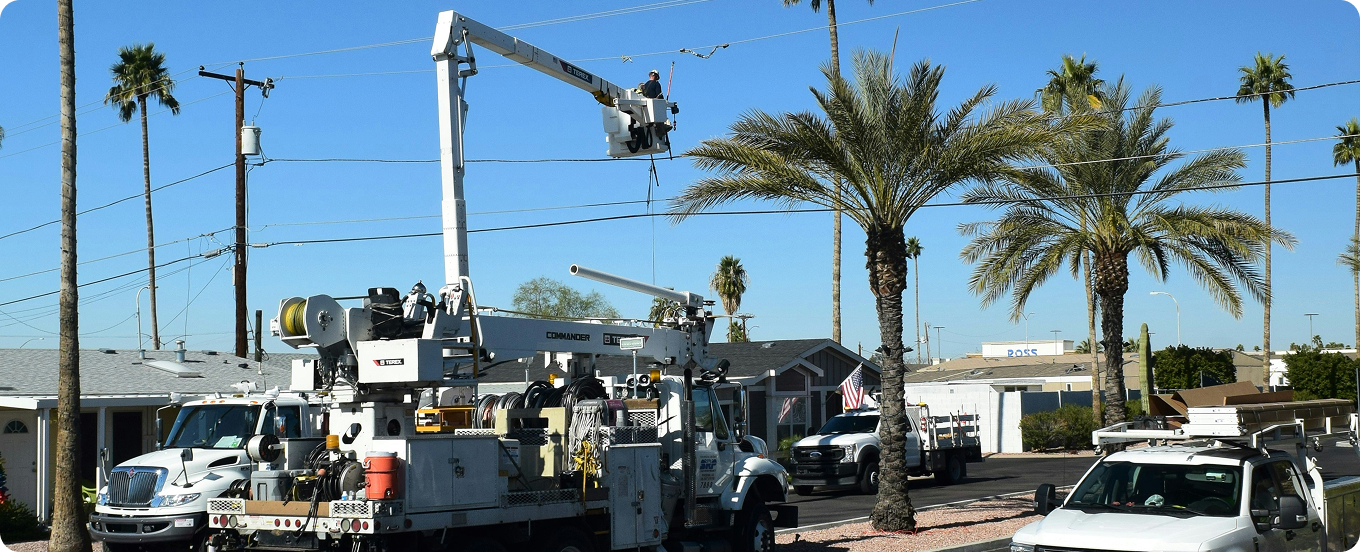
Arizona’s construction industry is one of the most active in the country. The Phoenix metro area continues to be one of the fastest-growing regions in the United States, attracting new residents, businesses, and major developments at a remarkable pace. Tucson maintains a steady construction market driven by both residential growth and commercial investment. And across the state, from Scottsdale and Mesa to Flagstaff and Prescott, contractors are building everything from single-family homes and retail centers to data centers and industrial facilities.
For any company looking to perform construction work in Arizona, the state’s contractor licensing requirements must be met first. Arizona has a well-defined licensing system with a single regulatory authority, and at the center of that system is the qualifying party, the licensed individual whose credentials allow a company to hold its license and perform work legally. This guide covers how Arizona’s framework works and what companies and licensed professionals need to know.
GET IN TOUCH
Start Connecting Today
Sign up now to join the network or request a licensed qualifier.
One Agency, One System: The ROC Runs Everything
Arizona takes the simplest possible approach to contractor licensing oversight: one agency handles it all. The Arizona Registrar of Contractors (ROC) is the single state agency responsible for licensing and regulating contractors across every trade in Arizona. There are no separate boards for electrical, plumbing, HVAC, or any other specialty. Everything flows through the ROC.
Compare this to states like Alabama, which has four separate licensing boards, or North Carolina, which splits oversight between a general contractor board and specialty trade boards. Arizona’s unified system means one application process, one set of rules, one enforcement authority, and one point of contact for all licensing matters. For companies and qualifiers who have dealt with multi-board states, Arizona’s simplicity is a welcome change.
That said, simplicity in oversight doesn’t mean simplicity in the licensing system itself. The ROC manages dozens of specific license classifications, and the details within those classifications matter.
Residential vs. Commercial: Arizona’s Fundamental Split
While the ROC is a single agency, it organizes its licenses into two main categories that affect everything from the classifications available to the bond amounts required: residential and commercial.
Residential licenses cover work performed on residential properties. The B (General Residential Contractor) classification is the broadest, covering new home construction, additions, and major renovations. Beyond the B classification, Arizona offers residential classifications for specific types of work like remodeling, swimming pools, fencing, manufactured housing, and dozens of other specialties.
Commercial licenses cover work on commercial, industrial, and institutional properties. The B-1 (General Commercial Contractor) classification allows a company to take on office buildings, retail centers, industrial facilities, and institutional projects. Commercial classifications tend to involve larger projects, higher bond requirements, and more complex compliance expectations.
This split matters for qualifying agents because the credentials required for a residential classification are different from those required for the same trade on the commercial side. A qualifier who enables a company’s residential roofing license isn’t automatically covering commercial roofing work. Companies that want to operate in both residential and commercial markets need qualifications that cover both categories, which may mean a single qualifier with dual credentials or separate qualifiers for each.
For qualifying agents, holding both residential and commercial classifications opens the widest range of opportunities. Professionals who are credentialed in only one category can still find plenty of work, but they’re limiting themselves to half of the market.
The One-Company Rule and Why It Shapes Arizona’s Qualifier Market
Arizona has a restriction that fundamentally differentiates its qualifying agent market from more flexible states: in most cases, a qualifying party can only qualify one company at a time under a given license classification.
This is a significant departure from states like Florida, where a qualifier can serve up to three companies simultaneously. In Arizona, if you’re the qualifying party for a general contracting company, you generally can’t also serve as the qualifying party for a competing general contractor. Your credentials are committed to one company per classification.
There are limited exceptions, but the general rule creates several market dynamics that both companies and qualifiers should understand.
For qualifiers, exclusivity means higher per-arrangement value. Because you can’t spread your credentials across multiple companies, the single company you qualify has your full commitment. This exclusivity is one reason Arizona qualifier compensation tends to be competitive, generally ranging from $2,000 to $5,000 per month depending on the classification, company size, and scope of work. Companies know they’re getting your undivided professional commitment, and compensation should reflect that.
For companies, finding a qualifier means finding someone who isn’t already committed. In states where qualifiers can serve multiple companies, the pool of available professionals is larger because even currently-active qualifiers might have capacity for another arrangement. In Arizona, every qualifier who’s already serving a company is effectively off the market for that classification. This makes the search for a qualifier more competitive and increases the value of working with a placement service that has access to a network of available professionals.
The one-company rule also raises the stakes when a qualifier leaves. If your qualifying party departs, you’re not competing for a qualifier who might also serve your competitor. You’re competing for a qualifier who will commit exclusively to your company. That commitment takes longer to secure and makes having a transition plan even more important.
What It Takes to Become a Qualifying Party in Arizona
The ROC has specific requirements for qualifying party candidates that are consistent across all classifications.
Four years of practical experience. Arizona requires at least four years of journeyman-level or higher experience in the trade covered by the license classification. The experience must involve actually performing the trade work, not just administrative or support tasks. The ROC evaluates experience carefully and may follow up with references to verify claims. Candidates whose experience doesn’t cleanly match the classification they’re applying for may face challenges in the approval process.
Two exams. Every qualifying party candidate must pass a trade exam and a business management exam. The trade exam tests technical knowledge specific to the classification, covering construction methods, building codes, safety practices, and technical requirements. A general contractor qualifier takes a different trade exam than an electrical qualifier or a plumbing qualifier. The business management exam is the same across all classifications and covers Arizona contracting law, the ROC’s rules and regulations, contract management, financial management, project management, and lien law.
Financial responsibility. The ROC requires license applicants to demonstrate financial responsibility, which may include financial statements, proof of a line of credit, or other financial benchmarks.
Bonding and insurance. Arizona requires a contractor’s license bond (the amount varies by classification and work volume), general liability insurance, and workers’ compensation coverage for companies with employees. The qualifying party should verify that all bonding and insurance requirements are maintained continuously, since a lapse can trigger license suspension.
How the ROC Defines the Qualifier’s Role
Arizona is among the more explicitly stated licensing authorities when it comes to what it expects from the qualifying party. The ROC defines the qualifying party as someone who exercises direct supervision and control over the company’s construction work. This isn’t aspirational language. The ROC enforces it.
The qualifying party must be a bona fide employee, officer, or member of the company. Arizona requires a genuine connection to the business and real involvement in its operations. The qualifier can’t be an outside name on the license. They need to be part of the company’s structure with the authority to influence how construction work is conducted.
The ROC’s enforcement of this supervision requirement is backed by its authority to investigate complaints and conduct audits. The qualifying party is the person the ROC looks to when evaluating the company’s compliance. When a complaint is filed, the qualifier is typically the first person the ROC contacts. Maintaining active oversight isn’t a suggestion in Arizona. It’s a documented requirement with real enforcement behind it.
The ROC’s Public Record System and What It Means for Qualifiers
Arizona’s ROC has a characteristic that sets it apart from many other state licensing agencies: it maintains a publicly accessible record of complaints, disciplinary actions, and license history for every licensed contractor in the state.
This matters for qualifying agents in a way that goes beyond the standard regulatory exposure discussion. In most states, disciplinary actions are a matter of public record if you know where to look, but the information isn’t always prominently displayed or easily searchable. Arizona’s ROC makes this information readily available through its website, and consumers, general contractors, and project owners routinely check these records when evaluating whether to hire a contractor.
For the qualifying party, this means that any regulatory issue that occurs under their watch doesn’t just affect their license status. It becomes part of a visible public record associated with their professional profile. A complaint or disciplinary action from years ago can follow a qualifier from one company to the next, because anyone checking the ROC’s records can see it.
This public transparency creates a strong incentive for qualifying parties in Arizona to be exceptionally diligent about which companies they agree to work with and how actively they maintain oversight. A single bad company partnership that results in complaints or disciplinary action can damage a qualifier’s marketability for years. Conversely, a clean ROC record is a valuable professional asset that qualifiers should protect carefully.
Desert Climate, Booming Growth: Where Arizona’s Demand Is Concentrated
Arizona’s construction demand is driven by two forces that interact to create one of the most active qualifier markets in the country: rapid population growth and climate-driven trade demand.
Phoenix metro is the epicenter. The greater Phoenix area, including Scottsdale, Mesa, Chandler, Gilbert, Tempe, and Glendale, accounts for the vast majority of Arizona’s construction activity. The region is attracting semiconductor manufacturing (TSMC’s fabrication facility in north Phoenix is a landmark project), data center campuses, corporate relocations, and a residential construction pipeline that has struggled to keep pace with population growth for years. General contractor qualifiers, electrical qualifiers, and HVAC qualifiers are in particularly strong demand in the Phoenix market.
HVAC is king in Arizona. With summer temperatures regularly exceeding 110 degrees in Phoenix and Tucson, air conditioning isn’t just comfort. It’s survival infrastructure. Every residential and commercial building in the desert requires robust HVAC systems, and the installation, maintenance, and replacement of those systems generates enormous year-round demand. HVAC qualifiers in Arizona need to understand the state’s mechanical codes, energy efficiency requirements, and refrigerant regulations, and they’ll never lack for companies that need their credentials.
Roofing faces unique desert challenges. Arizona’s intense UV exposure, extreme day-to-night temperature swings, and monsoon season create roofing conditions that are fundamentally different from what roofing qualifiers encounter in other states. The materials, methods, and codes that apply to roofing in a desert climate are specialized. Monsoon season (roughly June through September) brings periodic spikes in demand due to wind and water damage, but even outside of monsoon season, the relentless sun degrades roofing systems faster than in more temperate climates.
Tucson maintains a steady construction market driven by residential growth, University of Arizona-related development, and a growing commercial sector. The market is smaller than Phoenix but less saturated with qualifiers, which can mean less competition for positions.
Flagstaff and Prescott represent a different micro-market: cooler mountain climate, tourism-driven commercial development, and a residential market that caters to both full-time residents and second-home buyers from the Phoenix area.
The Qualifier’s Regulatory and Civil Exposure
The ROC can take disciplinary action against the qualifying party if the company commits violations, including fines, suspension of their ability to serve as a qualifying party, or revocation. As noted above, these actions become part of the ROC’s publicly searchable record, which amplifies the professional consequences beyond the immediate disciplinary penalty.
On the civil side, financial responsibility for construction defects, contract disputes, or property damage generally falls on the licensed entity. The qualifier faces personal financial exposure only in situations involving their own negligent supervision, fraud, or knowingly allowing unlicensed work under the license. A qualifier agreement with clear indemnification provisions is important in Arizona given both the ROC’s enforcement posture and the public visibility of any disciplinary actions.
When the Qualifying Party Leaves
When a qualifying party leaves a company in Arizona, the company must notify the ROC and designate a new qualifying party. Arizona has rules about how quickly this must happen, and failure to replace the qualifier within the required timeframe can result in license suspension. A suspended license means no permits, no bids, and no legal construction activity.
Because the one-company rule means every available qualifier is someone who isn’t currently committed to another company in that classification, finding a replacement in Arizona can be more competitive than in states with more flexible arrangements. Having a relationship with a placement service that maintains a network of available, vetted professionals is the fastest way to fill the gap.
Find Your Match
Whether you need a qualifying party for your Arizona contracting company or you’re a licensed professional interested in qualifier opportunities, Licensing Connection connects companies with vetted, experienced qualifiers across all major ROC classifications in Arizona and all 50 states. Most clients are matched within 48 hours, and every placement comes with a 14-day guarantee.
Arizona contractor licensing is governed by the Registrar of Contractors (ROC). Verify current requirements with the ROC before making licensing decisions.
Reviewed by the Licensing Connection team. Arizona licensing information is based on rules published by the Arizona Registrar of Contractors (ROC). Requirements can change; verify current rules with the ROC before making licensing decisions.