

Most companies don’t realize that a contractor’s license is only valid because a “qualifier” stands behind it, and strict state rules govern this qualifier relationship. As these rules vary for each state in the U.S., along with classifications, exams, and qualifier responsibilities, it creates a lot of confusion, and this confusion has a real cost. In 2025 alone, California’s Contractors State License Board issued 1,622 citations, including 736 to unlicensed contractors, and collected over $6 million in civil penalties.
So, before you hire an unlicensed contractor, know that your business could face real consequences, like stopped projects or voided contracts. That’s why, to help you make the right choice, we have this complete guide explaining everything, from how boards define qualifiers to how licensing works across multiple states. Let’s start.
GET IN TOUCH
Start Connecting Today
Sign up now to join the network or request a licensed qualifier.
| Key Takeaways 1.Understanding the Role of a Contractor Qualifier 2.Who Oversees Contractor Licensing in the U.S.? 3.Essential Requirements Before Applying for a Contractor License 4.Contractor Exams, NASCLA, and 3.Licensing Requirements Explained 5.How to Evaluate a Licensed Qualifier Before Hiring 6.Common Risks in Qualifier Agreements and How to Avoid Them 7.How to Prepare for Contractor Licensing in a New State 8.Reciprocity, Endorsement, and Multi-State Licensing Explained 9.What Licensed Qualifiers Should Consider Before Joining a Company 10.Understanding Qualifier Compensation and Working Arrangements |
Contractor License Qualification and Board Requirements in the U.S.
Every contractor license is only as valid as the qualifier legally attached to it. This section breaks down who that person is and which authorities govern their approval.
Who is a Qualifying Agent?
A qualifying agent is an individual whose verified construction experience, passed trade, business/law exams, and clean standing with the state board legally back a contracting business’s license. This means the qualifying agent is accountable for the license staying valid and compliant.
If you’d like to explore this role in more detail, please see our guide to the General Contractor License Qualifier.
How Contractor Boards Define a Qualifying Individual, Qualifying Agent, Responsible Managing Employee, and Officer Qualifier
Boards name one licensed person for each company, such as an owner, officer, partner, or employee, to be responsible for the license. This person has the required work experience, passes the required exam, and makes sure the business follows the rules set by the licensing board.
What Legal Responsibility Does a Qualifier Carry for Supervision, Code Compliance, and License Scope
- Supervision: The qualifier must exercise direct supervision and control over construction operations, make technical and administrative decisions, or check jobs for proper workmanship, as per Business and Professions Code Section 7068.1.
- Code compliance: The qualifier must ensure building, safety, health, and lien laws are followed.
- License scope: Responsibility is limited to the classification(s) the qualifier’s credentials cover, not the entire business.
How Board Terminology Changes By State and Why Those Naming Differences Matter Operationally
California uses RME/RMO, whereas Florida’s licensing statutes use the term “qualifying agent” for the same accountable role. If your business is expanding across states, you must map each board’s terminology to avoid misfiled applications.
Which Authorities Approve, Deny, and Enforce Contractor Licenses?
No single national body issues contractor licenses. Instead, the approval, denial, and enforcement sit with separate state and local authorities, each with its own scope of power.
The Role of Contractor Licensing Boards Versus Departments of Professional Regulation Versus Local Licensing Offices
| Authority Type | Primary Function | Example |
| Contractor Licensing Board | Issues all trade-specific licenses and sets exam/experience rules | CSLB (California) |
| Department of Professional Regulation | Oversees multiple regulated professions and houses trade boards | Florida DBPR/CILB |
| Local Licensing Office | Issues permits, as well as verifies the state license, before work begins | City/county building departments |
Which Authorities Control Examinations, Applications, Experience Review, and Disciplinary Enforcement
State boards such as CSLB and Florida’s CILB control applications, experience review, and discipline. The National Association of State Contractors Licensing Agencies (NASCLA) administers a standardized commercial exam, which is accepted across participating states, but disciplinary enforcement remains with each state board.
How NASCLA Supports Interstate Understanding Without Replacing State Board Authority
NASCLA achieves this by getting individual state boards to formally agree to accept one standardized exam in place of their own trade test. Each participating state agency independently lists itself on the NASCLA Participating State Agencies page as accepting the exam. However, remember that the license approval and business/law exam stay entirely with that state’s own board. So the “interstate understanding” is really just shared trust in one exam, not a shared licensing system.
License Readiness for Contractors: Experience, Exams, Entity Setup, and Compliance
Before a company can rely on any qualifier, it needs verified experience records, entity documentation, and required insurance in place from them. Readiness is a separate step from finding or vetting a qualifier.
What Makes a Contractor License Application Ready for Submission?
A submission-ready application will always have a:
- Verified experience.
- Correct entity records.
- Complete insurance/bond documentation on file.
Experience Verification, Project History, and Supervisory History Requirements Commonly Reviewed by Boards
Boards require proof of real, hands-on trade experience, like at least 4 years worked as a journeyman, foreman, supervisor, or contractor within the past 10 years, verified through employer statements, pay records, or project history.
How Entity Setup, Ownership Records, and Secretary of State Filings Affect Contractor License Applications
Businesses that are operating as corporations, LLCs, and partnerships must first register with the Secretary of State. The boards then cross-check the qualifier’s listed title against those official records to confirm they hold real authority in the business.
Where Insurance Certificates, Bonds, and Workers’ Compensation Fit Into License Readiness
Before issuing or reactivating a license, boards require proof of workers’ compensation insurance or approved self-insurance and a valid license bond on file. This ensures workers and the public are financially protected up front.
Contractor Exams, NASCLA Pathways, and Experience Waivers: What Actually Applies?
Exam obligations vary sharply by state and by whether the applicant already holds an out-of-state license or NASCLA credential. Understanding which pathway applies avoids duplicate testing.
When Trade Exams are Required and When Prior Qualifying Status or Prior Passage May Reduce Exam Obligations
| Scenario | Typical Requirement |
| New applicant, no prior license | Trade exam + business/law exam |
| Prior qualifier, license in good standing for 5+ years | Trade exam may be waived with a NASCLA Accredited Examination pass in participating states like California. |
| NASCLA exam passed within the required window | Trade exam typically waived; state business/law exam still required |
How NASCLA-Accredited Examinations Fit Into Multi-State Licensing Strategies
A contractor can pass the NASCLA exam once and use the results across all participating jurisdictions instead of retaking a trades exam in every state, streamlining multi-state entry.
Why Exam Eligibility, Reciprocity, and Endorsement are Often Misunderstood by Applicants
Applicants often assume that passing one exam guarantees licensure elsewhere. Most NASCLA states still require a separate business and law exam, so keep in mind that the exam only satisfies a part of the licensing process.
Qualifier Placement, Oversight, and Risk Management for Contractor Businesses
Once a company is ready to license, the next challenge is finding the right qualifier and making sure the relationship actually holds up under scrutiny. Therefore, this section covers vetting, risk, and oversight.
How Should Contractors Vet a Licensed Qualifier Before Entering an Arrangement?
Contractors should know that vetting isn’t just confirming someone has a license. Instead, it’s confirming that the license is clean, relevant, and backed by a person who can genuinely stand behind the work being done.
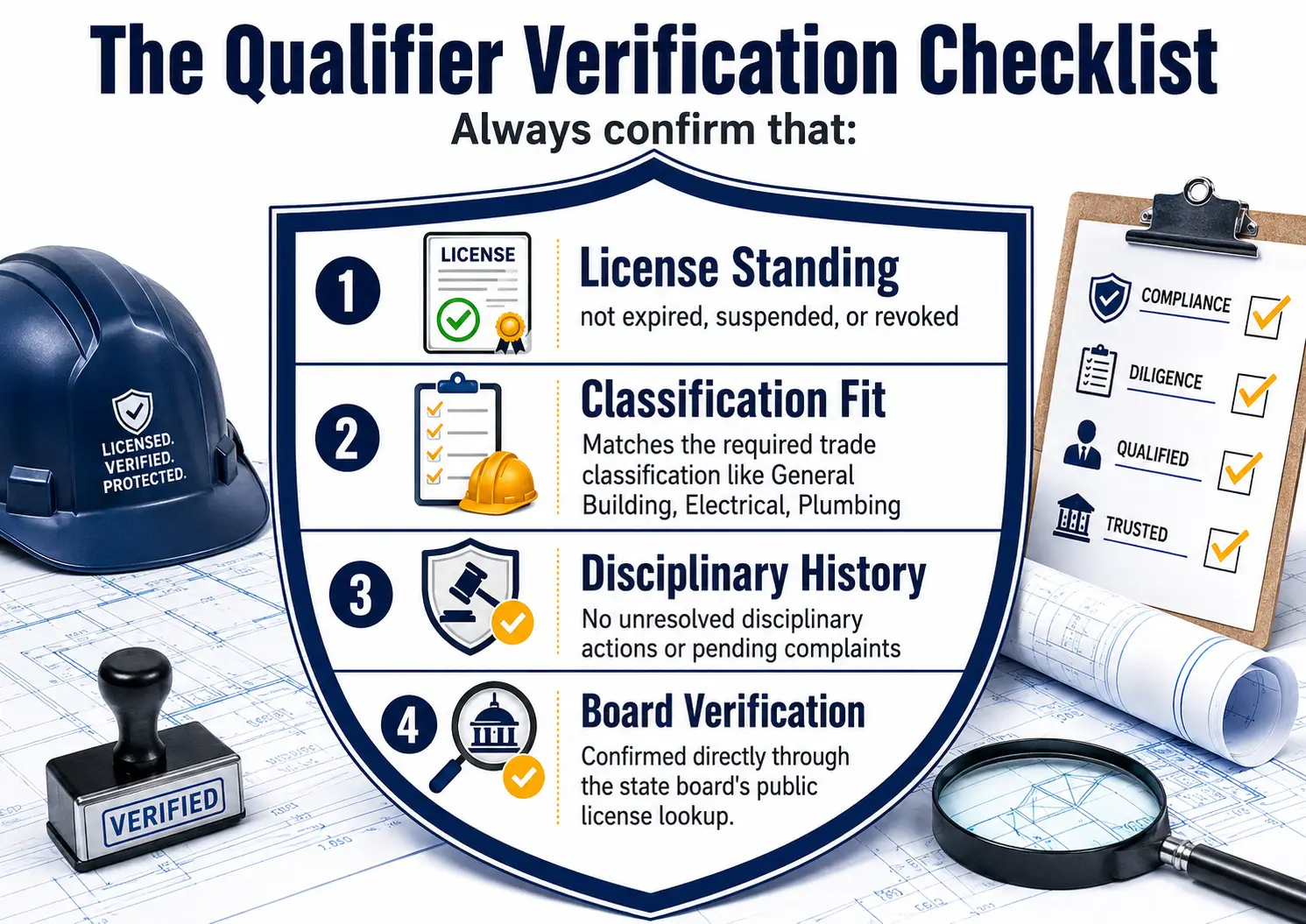
License Standing, Classification Fit, Disciplinary History, and Board Verification Checks Before Engagement
Before engaging any qualifier, run them through these four checks, all confirmed directly through official state board records, not the qualifier’s own word.
How to Evaluate Whether a Qualifier’s Experience Actually Aligns With the Company’s Trade Scope and License Class
Businesses can compare the qualifier’s documented project history and supervisory background against the specific classification and services the company performs, ensuring their real-world experience matches the license class and not just its title. For example, a qualifier licensed under a general building classification may not have hands-on electrical experience, even if their license technically permits electrical subcontracting.
Why do Reference Checks, Entity Fit, and Oversight Expectations Matter Before Any Agreement is Signed?
- Through reference checks, businesses can talk to people with whom the qualifier has worked before to confirm they actually supervised jobs themselves, instead of just putting their name on someone else’s work.
- Entity fit makes sure the qualifier’s license and experience genuinely match your company’s business type and trade.
- In oversight expectations, you agree in advance on exactly how involved the qualifier will be, so there’s no confusion or dispute later. Thus, the arrangement doesn’t look “nominal-only” if a board ever audits it.
What Risks Arise in Qualifier Relationships and How Can Companies Reduce Them?
The two biggest risks in any qualifier arrangement are the qualifier not being genuinely involved and the qualifier suddenly becoming unavailable. Companies reduce both by documenting real oversight and planning a replacement in advance.

Compliance Risk: When a Qualifier is Nominal on Paper But Not Operationally Involved to the Extent Required by Rule
Arrangements where a qualifier lends their license without meeting the board’s required level of supervision are treated as license misuse in many states. It exposes both the qualifier and the company to disciplinary action.
Business Continuity Risk if a Qualifier Exits, is Disciplined, or No Longer Supports the Licensed Entity
If a qualifying individual leaves, is disciplined, or withdraws support, the license can become inactive unless a replacement is designated within the state’s required notice window.
Why do Board Rules, Reporting Obligations, and Transition Planning Matter in Ongoing Qualifier Arrangements?
Boards require formal disassociation notice within a set timeframe, and the outgoing qualifier often remains accountable for prior work until that notice is processed, making transition planning essential.
Multi-State Contractor Licensing Strategy and Authority Mapping
Expanding into a new state means facing an entirely different board, classification system, and exam pathway. So, mapping the authorities below early prevents delays, rejected applications, and duplicated costs.
How Should Contractors Map Licensing Authorities Before Expanding Into Another State?
Before filing anything in a new state, contractors need a clear picture of exactly who governs the licensing there and how that system differs from what they already know.
How to Identify the Correct Board, Department, Classification System, and Application Channel in a Target State
Firstly, search the target state’s official licensing website directly, then locate its contractor classification list, and confirm which agency administers your trade. Finally, use that agency’s own application portal and not a general business registration site to file.
Why do Construction Licensing Frameworks Differ Between Statewide Boards, Trade Boards, and Agency-Administered Systems?
| Framework Type | How Licensing Works | Example |
| Statewide Board | One board licenses all construction trades under one system. | California Contractors State License Board (California) |
| Trade Board | Separate boards license individual trades, such as electrical or plumbing. | Texas Department of Licensing and Regulation and Texas State Board of Plumbing Examiners (Texas) |
| Agency-Administered | A larger department oversees licensing, with trade boards operating under it. | Florida Department of Business and Professional Regulation / Construction Industry Licensing Board (Florida) |
How Multi-State Contractors Should Organize Authority Lists, Deadlines, and License Dependencies by Jurisdiction
Just build one master tracker listing each state’s licensing authority, exam requirement, renewal date, and qualifier disclosure deadline in separate columns. Then review it monthly, since these items shift independently and rarely align across states.
Reciprocity, Endorsement, and Multi-State Expansion: What Do They Really Mean?
These three terms sound similar but carry different legal weight, and mixing them up is one of the most common as well as costly mistakes contractors make when expanding into a new state.
Why Reciprocity Rarely Means Automatic Approval and Still Requires Board-Specific Application Review
The reciprocity agreements typically let qualified licensees skip the trade exam, but the applicant still must submit a full application in order to meet the state’s other requirements.
How Endorsement Differs from Reciprocity and Why Companies Confuse the Two
These two terms are used interchangeably, but they trigger different processes. Many companies confuse them because both can reduce exam requirements, making it easy to assume either one guarantees automatic approval in a new state.
Where NASCLA Helps, Where it Does Not, and Why State-Specific Qualification Still Controls the Outcome
NASCLA helps by letting its accredited exam replace the trade-exam requirement in participating states. It does not help with business, law, or code exams. Because those remain state-specific, final approval always rests with the individual board.
Qualifier Careers, Compensation Logic, and Ongoing Responsibility
Being a qualifier means putting your license, your name, and your regulatory record behind someone else’s business. It is a decision that deserves the same scrutiny most people reserve for their own company.
What Should Licensed Qualifiers Evaluate Before Joining a Company?
Before agreeing to qualify a business, check:
- Whether the company is legitimate.
- Whether the role fits your license.
- How much regulatory responsibility would you personally be taking on?
How Qualifiers Should Assess Company Legitimacy, Entity Records, License Need, and Operational Fit Before Engagement
Check the company’s Secretary of State filings and ownership structure to confirm it’s real. Ask them for recent project records to prove a real license need, then visit or review a job site to confirm daily operations actually match your trade.
What Responsibility a Qualifier May Carry for Supervision, Compliance, and Board-Facing Accountability
A qualifier remains personally responsible to the board for supervising work, ensuring code compliance, and answering for violations. This accountability lasts for as long as they remain listed on the license.
Why Should Qualifiers Review Business Structure, Trade Scope, and Internal Control Expectations Before Proceeding?
Since the qualifier, not the business owner, is who the board holds accountable, an unclear structure means the qualifier could be blamed for work they never actually controlled. It can expose them to fines or license discipline for someone else’s decision
How Do Qualifier Compensation and Relationship Structures Usually Work?
Compensation isn’t standardized. It depends heavily on how much oversight a role legally demands, which is exactly why every arrangement needs its own written terms rather than a generic agreement.
Common Compensation Logic in Qualifier Arrangements and Why the Structure Depends on Scope, State, and Involvement Level
It means how much a qualifier earns depends on how much real work the role demands. A qualifier who just supervises one company occasionally, in a state with loose rules, usually gets paid less. A qualifier who actively manages several companies, visits job sites regularly, and works in a state with strict supervision rules takes on more responsibility and earns more because of it.
Why Should Written Agreements Address Term, Reporting Expectations, Change Events, and Exit Scenarios?
Without a clear term length, reporting schedule, and defined exit process, disputes over pay, involvement, or sudden departures become harder to resolve. A written agreement prevents ambiguity on all four fronts.
How Qualifiers Should Think About Business, Tax, Insurance, and Liability Questions With Professional Advisors
As liability, tax treatment, and insurance needs shift by entity type and state, every qualifier should have an attorney, accountant, and insurance advisor review their arrangement before signing anything.
Conclusion
Remember, a license is just a document. What actually protects a project, a client, and a business’s reputation is the person standing behind that license, doing the work the rules were written to guarantee. So, if your business needs any more help regarding this? Look no further than Licensing Connection. We help owners find, vet, and connect with licensed, board-verified qualifiers across the U.S., so you can move forward with confidence instead of guesswork.
Skip the licensing maze. Get in touch with us now, as we put the right qualifier in your corner, so your next project can move smoothly.
FAQs About Contractor Qualifiers and State Licensing Rules
How long does a contractor license approval typically take?
The processing time varies by board and application completeness. However, incomplete applications, missing bonds, or unverified experience commonly cause multi-month delays.
During an ownership change or business sale, what happens to a license?
Ownership or qualifier changes generally require board notification and, in sole-owner cases, the license is non-transferable to a new owner.
Is it always required that a qualifier be a state resident or U.S. citizen?
Not always. Florida, for example, does not impose a strict residency requirement for qualifying agents. So these rules vary by state.
What happens legally if a contractor works without a required license?
Unlicensed contracting typically triggers fines, contract unenforceability, and potential misdemeanor or civil penalties under respective state laws.
Are contractor licenses and disciplinary records publicly searchable in the U.S.A?
Yes, disciplinary actions become part of a permanent public record searchable through the board’s license database.