
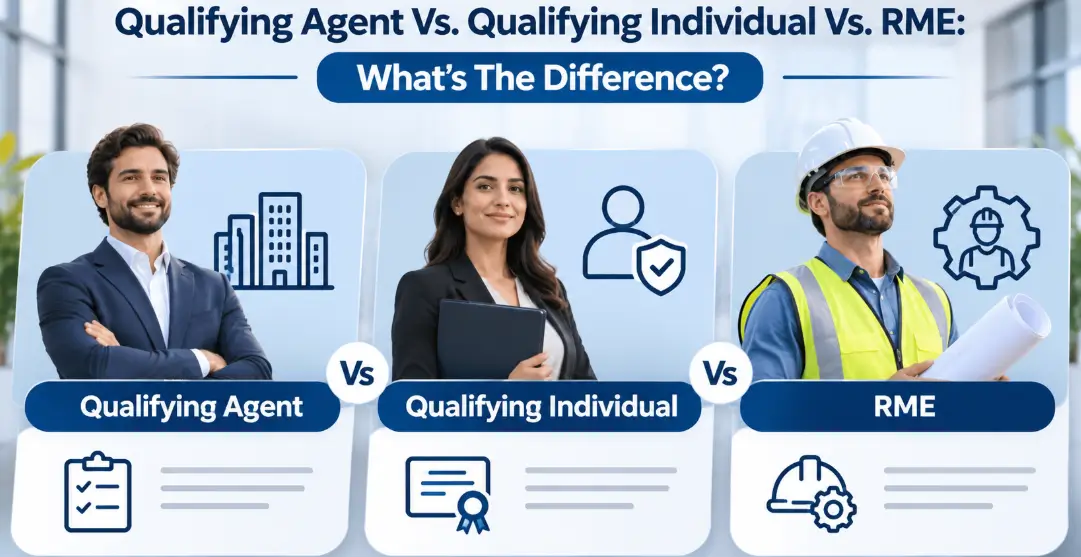
When a business applies for or maintains a contractor license, the individual responsible for meeting the licensing requirements can play a critical role in keeping the company compliant. However, terms such as qualifying agent vs. qualifying individual and Responsible Managing Employee (RME) may be used in contractor licensing discussions. But their meanings and requirements can differ depending on the state and licensing authority. In some jurisdictions, these terms may describe distinct positions, while in others, similar responsibilities may be assigned under different titles.
So understanding this terminology is important for businesses while selecting a qualifier, preparing a license application, or evaluating changes to their qualifying personnel. This guide takes a closer look at these roles and the regulatory distinctions that businesses should understand.
Insights On Qualifying Agent Vs. Qualifying Individual Vs. RME
Contractor licensing terminology varies by state, making it important to distinguish qualifying agents, qualifying individuals, RMEs, and RMOs before selecting a qualifier. Their responsibilities, business relationships, licensing authority, bonding requirements, and eligibility can differ significantly. California rules further vary by business structure, including sole proprietorships, partnerships, corporations, and LLCs. Understanding these distinctions helps contractors identify appropriate qualifying personnel, maintain licensing compliance, and make informed decisions when changing or establishing qualifying arrangements.
What Is a Qualifying Agent, Qualifying Individual, RME, and RMO?
Qualifying Agent (QA)
A qualifying agent is the person designated to qualify a contractor business for licensing. They generally provide the required technical experience, knowledge, supervision, or responsibility for the licensed work.
Qualifying Individual (QI)
In contractor licensing, a qualifying individual is someone whose experience, knowledge, examination results, or credentials meet the licensing authority’s requirements for a specific license or classification. This qualifying individual definition can vary by state, as each licensing authority has its own qualification and supervision requirements.
Responsible Managing Employee (RME)
When the qualifier is an employee of the contracting business, the role may be designated as a Responsible Managing Employee (RME). This individual must meet licensing requirements and exercise direct supervision and control over licensed activities.
Responsible Managing Officer (RMO)
When comparing RME vs. RMO contractor requirements, the primary distinction is the qualifier’s relationship with the business. An RME serves as an employee, while an RMO is a qualifying individual who holds an officer position within the contracting business. This individual is responsible for meeting qualification requirements and exercising direct supervision and control over licensed operations.
Not sure which qualifying role your business needs? No worries, our team helps assess your licensing requirements, identify the appropriate qualifier structure, and connect you with qualified professionals.
Due-Diligence Checks for Contractor Qualifier Selection
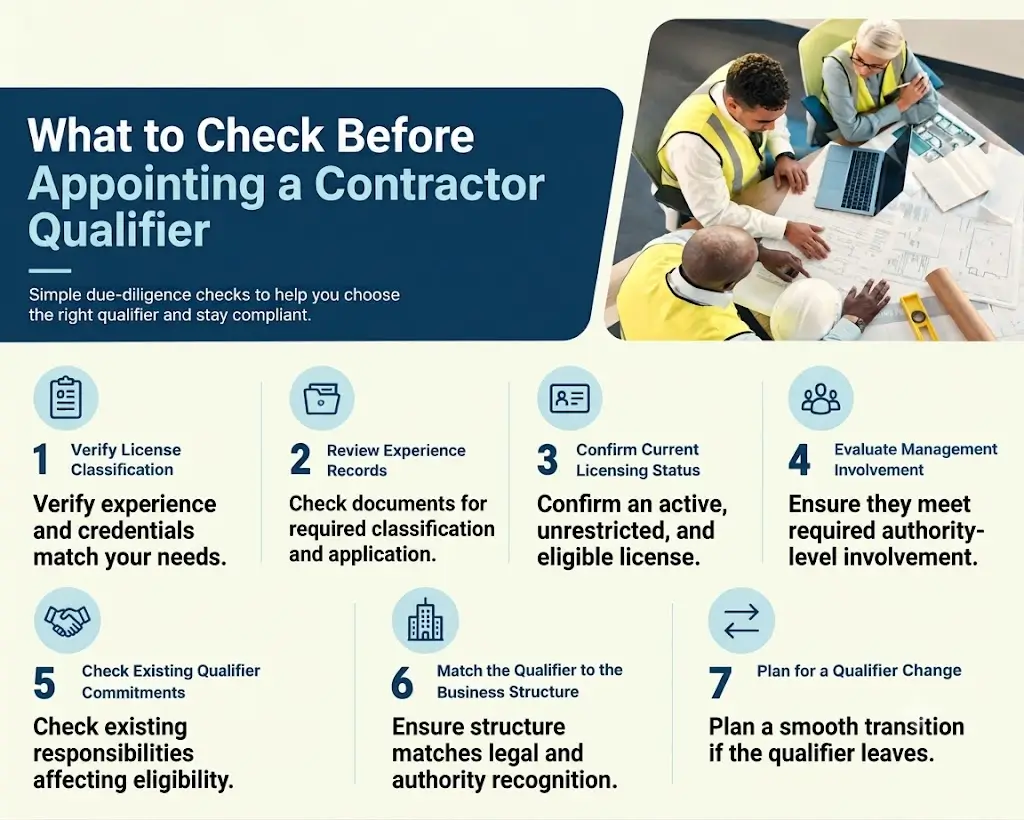
When working with a contractor qualifier, taking the right steps from the beginning can help the licensing process move smoothly. Therefore, a few crucial checks should be completed beforehand.
Qualifying Agent Vs. Qualifying Individual Vs. RME Vs. RMO: Key Differences
Before appointing or working with a contractor qualifier, understanding how these terms differ can make it easier to identify the right role and assess the applicable eligibility criteria. Clear distinctions also help you interpret licensing requirements more accurately and avoid applying one role’s rules to another.
Feature |
Qualifying Individual (General) |
Qualifying Agent (State Term) |
RME |
RMO |
|---|---|---|---|---|
Role Type
|
Person who meets state requirements and qualifies the contractor license.
|
State-specific title for the person qualifying a contracting business.
|
California employee who serves as the business’s qualifying individual.
|
California officer who serves as the corporation or LLC’s qualifier.
|
Ownership Rule
|
Ownership eligibility depends entirely on the applicable state’s licensing rules.
|
Ownership requirements vary according to each state’s specific regulations.
|
Must be a bona fide employee permanently employed by the business.
|
Must hold the required officer position within the licensed business.
|
Simultaneous Licenses
|
Number of licenses permitted depends on the applicable state regulations.
|
Each state determines how many businesses one agent may qualify for.
|
California allows an RME to qualify only one active license.
| |
Bond Requirement
|
Qualifier bond requirements vary according to state licensing regulations.
|
Financial responsibility requirements differ between states and license types.
| ||
Time Commitment / Working Role
|
Must satisfy the supervision requirements established by the licensing jurisdiction.
|
Required involvement depends on the state and agent classification.
|
Performs qualifier responsibilities through an officer-level management position.
|
How to Determine Which Qualifying Role Applies to Your Business
- Start with your state’s licensing terminology: States do not use “Qualifying Agent,” “Qualifying Individual,” RME, and RMO interchangeably. Check the licensing authority’s rules before selecting a title for your business, as the state may require a properly licensed contractor to qualify the business as its qualifying agent.
- Sole ownership: CSLB allows the owner or an RME to serve as the qualifying individual. Therefore, RME is relevant when the qualifier is an employee rather than the business owner. CSLB
- Partnership: The qualifier must be either a qualifying partner or an RME. As mentioned in the CONTRACTORS STATE LICENSE BOARD, a qualifying partner must be one of the partnership’s general partners, while an RME qualifies as the firm’s employee.
- Corporation: A corporation can designate a current corporate officer as its RMO, or use an RME as its qualifying individual. However, the selected title must match CSLB’s business records. Businesses that are specifically reviewing California RMO requirements can also explore California RMO licensing for additional service information.
- LLC: An LLC can designate an RMO, Responsible Managing Manager, Responsible Managing Member, or RME as its qualifying individual under CSLB rules.
If you are already a licensed professional looking to qualify a contractor business, become a qualifier to explore how your qualifications may align with contractor licensing needs.
Conclusion
Choosing the right qualifier can directly affect your ability to maintain licensing compliance and keep projects moving. Licensing Connection helps contractors identify and connect with vetted licensed qualifiers matched to their state, trade, and business needs. With compliance-focused matching, nationwide coverage, and flexible placement options, we simplify qualifier placement while helping businesses move forward with greater confidence and fewer licensing delays.
If you are looking for the right hand to match your licensing needs, our compliance-focused placement service connects contractors with vetted qualifiers aligned with state requirements, trade experience, and business goals.
Frequently Asked Questions About Contractor Qualifying Roles
What documents are needed to appoint a contractor qualifier?
Requirements vary, but applications commonly require experience verification, identification, employment or ownership information, signatures, examinations, and applicable licensing forms.
Does a qualifier need construction experience?
California generally requires four years of verifiable experience within the relevant classification, gained at journeyman, foreman, supervisor, or contractor level.
Can an out-of-state contractor qualify a California business?
Yes, out-of-state individuals can apply for California licensing when they satisfy California’s qualification requirements and applicable reciprocity provisions.
Do a qualifier work for multiple contractor businesses?
Some states permit qualifiers to serve multiple businesses under specific conditions, while others impose strict limits based on employment and ownership.
Does changing a qualifier require a new contractor license?
Usually, businesses update qualifying personnel through the licensing authority rather than obtaining an entirely new license, subject to state-specific procedures.